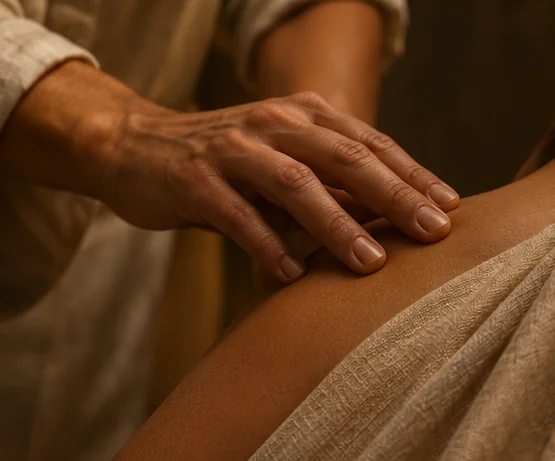
In a first myofascial release session, the biggest surprise may be a pause. The practitioner’s hand rests on the back, the contact stabilizes and, for a moment, it seems as if nothing is happening. If you are used to the classic massage with long strokes and kneading, the change is noticeable. In the myofascial approach this stay is often part of the work. It also gives you time to discern whether what you’re feeling is a comfortable pull, a pressure that tires you, or just a touch you’d like moved elsewhere.
What does the word fascia mean
Think what happens when you pick up a cup from the table. The fingers close, the wrist stabilizes and the elbow bends. The muscles involved are surrounded and separated by connective tissue. Fascia is part of this tissue and is found in many areas of the body. The term “myofascial” describes this close relationship of muscle and fascia. In a session, the contact is through the skin, so the visitor feels overall pressure and movement in the area. It does not need to be able to identify which sublayer is receiving the contact.
The word “liberation” is the standard name for the method and can conjure up a very specific image. One imagines a knot snapping open and waits to feel a distinct ‘click’. The actual experience can be much quieter. Maybe a position seems more comfortable, maybe the contact becomes less intense, or maybe you don’t notice any difference. Neither of these impressions alone proves that the structure of a tissue has changed. It describes how you felt at that moment and is enough to start a conversation.
The difference is first seen in the rhythm
In classic massage you can often follow an entire path from the shoulder to the back and back. In myofascial work a wide contact can stay in almost the same position, while the direction of tension changes little. The feeling sometimes resembles a gentle stretch under the palm. Other times the visitor pays more attention to the weight of the hand. The specific description is more valuable than a general designation like “deep” because it helps you understand what you will be asked to tolerate or comment on.
Limiting slippage explains why some professionals use minimal product or work without oil. If the contact is constantly sliding, it feels different than a palm that remains steady. Others incorporate small sections of myofascial work into a larger oil massage. Both descriptions may appear in directories. Before choosing, ask whether you are talking about a full session of slow steady contact or a few such movements within a full-body program. The answer significantly affects the experience.
How to choose a useful starting point
Suppose that you have been spending more time at the sewing machine for the last few days, and towards evening you find it difficult to find a comfortable position on your shoulders. It is helpful to explain when you notice fatigue, where your forearms rest, and what you would like from a wellness visit. Maybe your goal is just to enjoy twenty quiet minutes with the support of your hands. The information about your activity gives context to the choice of position. It is not enough for someone to decide that there is a specific damage or that it was caused by the way you sit.
A different example is a musician who wants to get his back comfortable before a long car ride. That’s where it matters if he gets tired of the immobility. A method with long pauses may suit him in a lateral position with a pillow, while face down he may struggle. If he only describes wanting to “relax the fascia,” the practitioner knows little about his true priority. If he describes the need to change positions easily, they can work together to create a session that is actually enjoyable for him.
Because pressure alone says little
A soft, broad contact for a long time may become tiring, while a slightly firmer contact of short duration may seem comfortable to you. Tension has more than one dimension. They measure the area, the range of the contact, the direction, its duration and the position in which your body is. So “less” is a good start, but one more word often helps. You can say “less time here”, “wider contact” or “let’s change the angle of my hand a bit”.
Equally important is what you do when the contact is pleasant. A short “I feel comfortable here” gives the professional a point of reference. If the region later changes, the previous answer does not bind the next one. Just because you liked the steady contact on the back doesn’t mean you want it with the same duration on the forearm. Nor do you have to wait until pain occurs to ask for a ride. You may just have had enough of a feeling and prefer a change of pace.
What does before and after motion mean
Some sessions include a brief discussion of some daily movement. If you want an example, think about how you feel when you roll up a jacket sleeve or when you reach for a low shelf. Such a reference helps to express in simple words what interests you. It is not necessary to make a move that bothers you to prove that it bothers you. If the goal is to investigate a persistent limitation, a health professional evaluation is a different service and requires a different discussion.
After the appointment you may notice that the same usual movement seems easier. It is perfectly legitimate to enjoy the difference and report it. But try to remember the conditions of the comparison. Now you’ve been lying down for a while, you’ve taken off the heavy jacket and maybe you’re in a warmer room. A momentary change in comfort is personal observation. For a persistent problem, it is more important how you function in everyday life and what the person monitoring your health values.
What we know about efficiency
H Mayo Clinic examines myofascial release in relation to back pain and highlights the limitations of available research. This is of practical importance when you read a service description that promises permanent change from the first visit. A pleasant session, a change in your own feeling and a proven treatment for a specific diagnosis are different matters. For the first, your personal preference is enough. For the latter, clinical assessment, appropriate training and case-specific data are needed.
Also pay attention to what exactly has been studied when you see an impressive title. A survey may look at people with a specific problem, use repeated sessions, and measure comfort over a short period. This does not automatically lead to a conclusion for every person who books an individual visit to a wellness area. A useful question to ask the practitioner is what part of their recommendation is based on your own preference and what part is about a clinical goal. The answer helps to choose the right place for the reason of the visit.
How it compares to deep tissue and foam rolling
Deep tissue often attracts people seeking targeted, steady work in areas of tension. It can be slow-paced, just like the myofascial approach. If the label doesn’t help you choose, ask for a small sample of the feeling. Will there be movement along the range or more staying in constant contact? Will oil be used? Will you change positions often? These questions are meaningful even if the practitioner combines techniques. They allow you to choose based on how you want to spend your time.
At the other end of the comparison is the roller that you may have seen in gyms. In foam rolling, the person himself controls the tool and supports part of his weight. The effort, position and degree of involvement are different from a professional session where you can lean on pillows and describe how you feel. Just because two activities use the term “musculofascial” does not make them interchangeable. If your main criterion is comfortable immobility, the presence of this word in the title is not enough to make up your mind.
A description you can use in the reservation
Try to describe your preference in one sentence that includes area, rhythm and position. “I’d like slow, wide contact on the back and shoulders, with the ability to turn to the side if I get tired.” Then let the professional explain how he would organize it. If he suggests that you split the time between several areas, ask where most of the time will ultimately be given. You’ll walk away with a clearer picture of what you’re buying and whether this method fits the experience you have in mind.
There is one more detail worth discussing when two people use the word “late.” For one it means silence, closed eyes and minimal changes. For the other it means time to understand what is happening, with short explanations in transitions. If you belong to the second case, ask to be informed before they switch sides. If you belong to the first, agree that you will speak when you want adjustment. This is how communication takes on the rhythm that serves you.
Also think about whether you want the session to end in the same area where it started. Some prefer this return because they can compare two moments of the same visit. Others want to stay in the last comfortable position and end the contact there. It’s a small choice that can make the ending even more enjoyable.
If there is a recent injury, unexplained pain, or a specific limitation that is worsening, first seek personal guidance from a health professional. If you are looking for a peaceful wellness experience in Athens, you can call Mansion Escape Massage at 6946080253 and ask which options support the contact and pace you prefer. The most useful information from the phone is a specific description of what will be done during your time.