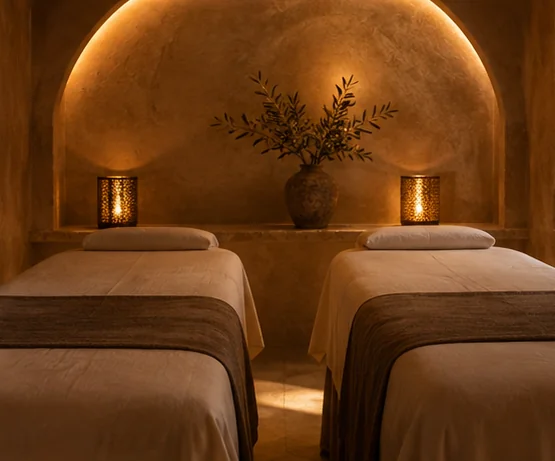
In many massages the oil is in the room for a simple practical reason. It helps the hand to move over the skin. In Abhyanga the product is at the center of the practice itself. Its choice, quantity, application to the body and the sensation it leaves are elements of the experience worth discussing before lying down. If you have heard the term “Indian hot oil massage” and are wondering what exactly you are getting into, start with a distinction. Abhyanga has a specific place in the Ayurvedic tradition of India, while a modern wellness catalog may describe its own adapted version.
What does Ayurvedic tradition mean by Abhyanga
The All India Institute of Ayurveda describes Abhyanga as the application of plain or specially prepared oil to the body, accompanied by gentle massage. In traditional descriptions, the use of oil is also associated with daily care. A professional studio appointment is another occasion. It has an agreed duration, uses specific equipment and is organized around contact with another human being. The distinction helps to understand why a book may refer to a short daily practice at home, while a catalog offers a much longer session under the same name.
In some texts you will also come across the concept of dosha. This is a term in the Ayurvedic system that can be used to traditionally explain a choice of oil or rhythm. If the venue uses this language, ask them to explain what it means for the actual session. Specific answers are “we use this product”, “we give more head time” or “the pace is gentle”. A traditional interpretation may have cultural interest. It is not a medical diagnosis nor a sufficient basis for changing treatment or attributing a symptom to some supposed imbalance.
The first question concerns the oil itself
Sesame oil is often mentioned in method descriptions, but there is no reason to assume that all sites use exactly the same formulation. It can be a single vegetable oil, an oil with vegetable extracts or a ready-made cosmetic with more ingredients. The expression “traditional blend” doesn’t tell you if it contains fragrance or some material you want to avoid. Ask which product applies, if an ingredient list is available, and if a neutral alternative can be used. If you know you have an allergy to an ingredient, inform before closing and avoid products with unclear composition.
Fragrance has more than one source. A vegetable oil can have its own characteristic smell even without the addition of an aromatic ingredient. It can also be that the space perfumes the room regardless of the contact product. If you prefer a mild environment, ask separately for the oil and for the air in the room. The phrase “we do not use essential oils in the mixture” solves only one question. The phrase “I would like a mild smell in the product and no fragrance in the room” describes much better the desired effect.
Because rate matters as much as quantity
The feel of the oil changes as it is spread. A small amount can be used for a short stroke on the forearm. On a larger surface, such as the back, the application can be done in successive passes and followed by time with gentle movements. The visitor perceives the change between the first contact, when the product still stands out on the skin, and the subsequent passes, when the hand moves more evenly. This repetition gives Abhyanga a special character, even when the equipment of the room is very simple.
If the feeling of oil remaining on the surface bothers you, say so in time. Maybe you prefer a smaller amount, wiping after each area, or another method with a different texture. If you still enjoy the constant sliding, you can ask for longer runs and fewer changes of direction. The two visitors giving these opposing instructions are not arguing about what is “correct” application. They describe how they perceive the same material. The useful discussion is how much the service can be customized without losing the element you chose it for.
From head to toe or just the body?
Full body Abhyanga may include head and feet work, depending on site protocol. This affects your daily life more than a short description promises. If oil is applied to the scalp, you will need to think about when and where you will wash your hair. If you’ve ruled it out, explain if you accept gentle head contact with clean hands or if you want the area to be skipped entirely. The two options are different and the professional can prepare accordingly.
For plinths, the practical issue is the transition from the table to the floor. If product remains on the skin, ask for it to be wiped off before getting up and make sure you have firm pressure. If you are going to wear open shoes or walk a lot, say so at the beginning. Likewise, if you’re going straight into keyboarding work, ask that your palms remain clean. These practical details take nothing away from respect for tradition. They allow the appointment to fit comfortably into your actual day.
Does one or two people apply the massage?
Descriptions of Ayurvedic care include application by two practitioners coordinating their movements. You will also find sessions from one person. The number of people working changes the distribution of contact and the way of communication. In the session with a professional you can more easily follow the route from area to area. With two, attention is shared in simultaneous movements and agreement on pressure needs to be clear to both. Ask which version the specific price refers to and if the entire stated duration is realized with this composition.
If it’s the first time you’ve tried synchronized intercourse, you can ask for a short explanation before you lie down. Who will guide the position change? Who do you turn to if you prefer to have the pressure reduced on only one side? How will you take a break if the simultaneous routes tire you? A clear answer makes the session more predictable. If the idea of two people in the same space makes it difficult for you, you have every reason to choose an individual application. Quality is not measured by the number of hands involved.
Another Abhyanga, another Shirodhara
One of the most common images in promoting Ayurvedic wellness shows a pot over the head and a thin stream of liquid towards the forehead. This image refers to Shirodhara, a different practice than applying oil with the hands to the body. A package may combine the two experiences, but the presence of the photo next to the title “Abhyanga” is not enough to conclude that. If this is exactly what you want to try, ask specifically if a flow is included in the forehead, how long it lasts and how the hair care is organized afterwards.
Also compare Abhyanga with an aromatic massage of your choice. In aromatherapy the focus may be primarily on the smell of a diluted essential oil. In Abhyanga the emphasis falls on the application of the oil as part of the Ayurvedic practice. The two experiences may use a scented product, but that doesn’t make them the same. If what you want is to choose a perfume, take a look at how the perfume selection is presented. If you want to experience Ayurvedic care, ask about the practitioner’s training and the sequence that follows.
Reading a “detox” promise
Descriptions of Abhyanga sometimes use the word ‘detoxification’. As a single word in a list it does not specify what substance is supposed to be removed, how it is measured, or what clinical outcome is expected. For a wellness visit there are several more tangible criteria. Do you like the feel of oil? Do you want slow motion that repeats itself? Are you interested in the history of the practice? These questions are enough to make a personal choice without basing the decision on unsubstantiated therapeutic promises. If there is a symptom that concerns you, discuss it with a health professional.
An example of reservation without ambiguity
Imagine you are traveling to Athens and want a quiet afternoon before a night out. You’re interested in the texture of hot oil, but you’ve already combed your hair and don’t want a strong scent on your clothes. A brief description of these preferences prevents several misunderstandings. “I would like the body version, with a mild product, no oil on the head. Is there time and opportunity for me to dry off or shower before I leave?’ With this question you are asking for exactly the experience you are interested in, along with a practical piece of information that is often missing from the list.
Dwell time is just as important as contact time. Dressing after an oil-rich session may require a few extra minutes. Confirm if towels are included, if there is a private changing area and how soon the next appointment is. If you have delicate fabric or a garment that stains easily, take something simpler to return. That way you’ll keep your focus on what you came to know, instead of constantly wondering how to protect a shirt.
If you want to keep a useful note afterwards, pick the detail that made the biggest difference. It may have been the time the professional limited the amount of oil on the hands or the choice to wipe the back before turning on your back. These specific elements easily carry over to the next conversation, even if you visit another site. Instead of asking for ‘the same Ayurvedic massage’, you can say which feel of the product you prefer, how you want the time to be shared and when you need a little break. The personal experience thus acquires a description that is understood even by someone who was not present.
For information on the experiences available at Mansion Escape Massage in Athens, call 6946080253If you are specifically interested in Abhyanga, please confirm availability, ask for the name of the oil and explain if you want head application. It’s three little pieces of information that turn a general curiosity about Ayurvedic massage into a specific, personal choice.